
Endometriosis: Symptoms, Diagnosis & Treatment
Do you experience severe pain during your periods? Does it pain while having intercourse? Are you unable to have a baby? You could be suffering from a condition called endometriosis.
What is Endometriosis?
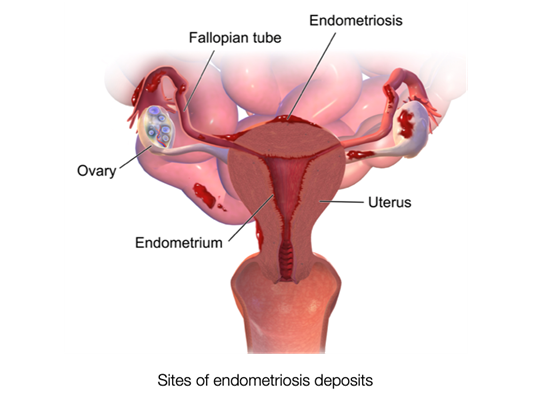
It is a condition in which the endometrium that normally lines the inside of the uterus, is present outside the uterus. It could be present at various sites like the ovaries (chocolate cyst – comments site), as peritoneal deposits, between the vaginal wall and the rectal wall, in the uterus (adenomyosis), in the bladder, over the gut. Few rare sites like it being present in the lungs have also been reported.
What explains the presence of endometriotic tissue outside the uterus?
There are many theories which attempt to explain the presence of endometrium outside the uterus. One of the most plausible theories is Retrograde menstruation in which there is flow of the endometrium outside the uterus into the pelvis, causing the endometrium to get deposited there and grow cyclically with every menstruation. Others include transformation of peritoneal tissue to endometrium through hormonal and/or immunological factors, which is termed as metaplasia. It is also posed to be initiated by genetic causes and presence of stem cells. Stem cells have the ability to regenerate themselves into any kind of cell, for example, deposits of undifferentiated cells which turn into endometriotic deposits.
When should one suspect endometriosis?
A classical triad of pain during periods, infertility and pain during intercourse strongly points in favour of endometriosis and it must be suspected and evaluated if you are experiencing these symptoms. Apart from these, women with endometriosis may also present with pain with bowel movements or urination, particularly of increased intensity during menstruation, depending on where the endometriotic deposits are located. There could also be bloating of abdomen which is a very non specific complaint. These deposits swell up during menses so any cyclical pain in the rectum or in lower abdomen goes in favour of endometriosis.
Why do these symptoms occur?
The cyclical hormonal changes of the menstrual cycle affect the misplaced endometrial tissue in the pelvis and elsewhere. This tissue also grows and thickens with estrogen and progesterone and bleeds when these hormones are withdrawn. This leads to inflammation and adhesions amongst the organs nearby. Old endometriotic deposits become fibrotic and can cause dense adhesions in the pelvis. These changes lead to pain. The severity, however, does not correlate with the pain. A woman with mild endometriosis may have severe pain and a woman with severe endometriosis may not have severe pain. The adhesions around the tubes and ovaries lead to difficulties in the sperm reaching the egg which leads to a pregnancy. Presence of endometriosis may also negatively affect the quality of eggs that the woman is producing as it produces a toxic environment. It may also also cause problems in the embryo attaching inside the uterus, a process called as implantation. These are the reasons of infertility in a woman with endometriosis. When the endometrium gets deposited in the ovaries and bleeds cyclically it leads to formation of a chocolate cyst. Presence of this chocolate cyst can lead to pain during intercourse.
When should you visit a doctor?
If you are experiencing any pelvic pain, pain during intercourse or infertility, you must visit your gynaecologist to evaluate the cause of your symptoms. You must also visit if you have excessive pain during passing stool that increases in intensity during menstruation.
How is endometriosis diagnosed?
A chocolate cyst will be visible on a pelvic ultrasound. It will also be picked up on a MRI. The gold standard test for diagnosis is a Laparoscopy. The procedure involves visualising the pelvis to look for any endometriotic tissue in the pelvis that may not be visible on ultrasound and or MRI. These deposits which are in the form of reddish blue deposits over the peritoneum, or thick nodules between pelvic organs or as fibrotic adhesions in the pelvis, can also be excised and sent for biopsy, which confirms the diagnosis.
How is it treated?
The treatments depends upon what the patient desires, whether she is infertile or predominantly wants pain relief.
Pain
Medication – drugs that suppress menstruation which suppress the growth of these endometriosis deposits and hence stall the disease process. These drugs offer temporary relief from symptoms. However ,they cannot be used long term as they have a side effect profile that prevents their use for long Dienogestcan be taken upto 5 yrs. It is a progestogen which acts by suppressing estrogen production hence suppressing endometrial growth GnRH Agonists – act by suppressing menstruation. Usually cannot be used more than 6 months Oral contraceptives – suppress menstruation and hence endometriosis growth Surgery – Laparoscopic excision of endometriotic deposits, chocolate cysts, endometriotic nodules Definitive surgery in a woman who has completed her child bearing process is removal of uterus and both ovaries via laparoscopy. This is sometimes necessary in very severe forms of endometriosis
Infertility
For infertility, these women may require additional treatment in the form of Intrauterine insemination or even In Vitro Fertilization as they are unable to get pregnant. This may need to be combined with a surgery that removes the endometriosis deposits and excises the chocolate cysts in order to pose the best chance for conception. GnRH agonists can be used for patients for infertility prior to IVF treatment. Other medications cannot be used while trying to get pregnant as most of these are contraceptives as they supress menstruation and hence will prevent a pregnancy. The best treatment for endometriosis is a pregnancy as no menses for 9 months keeps the endometriotic growth in check and does not allow progress of the disease.
The definitive treatment of the disease is removal of the uterus and ovaries and is sometimes necessary in severe forms of endometriosis. Ofcourse it can only be offered once child bearing is complete. However, the newer modalities of assisted reproduction treatment and skilled endoscopic surgeons that are able to remove these endometriotic deposits are a ray of hope in this feeling of despair. So fear not, we are here to help you !